
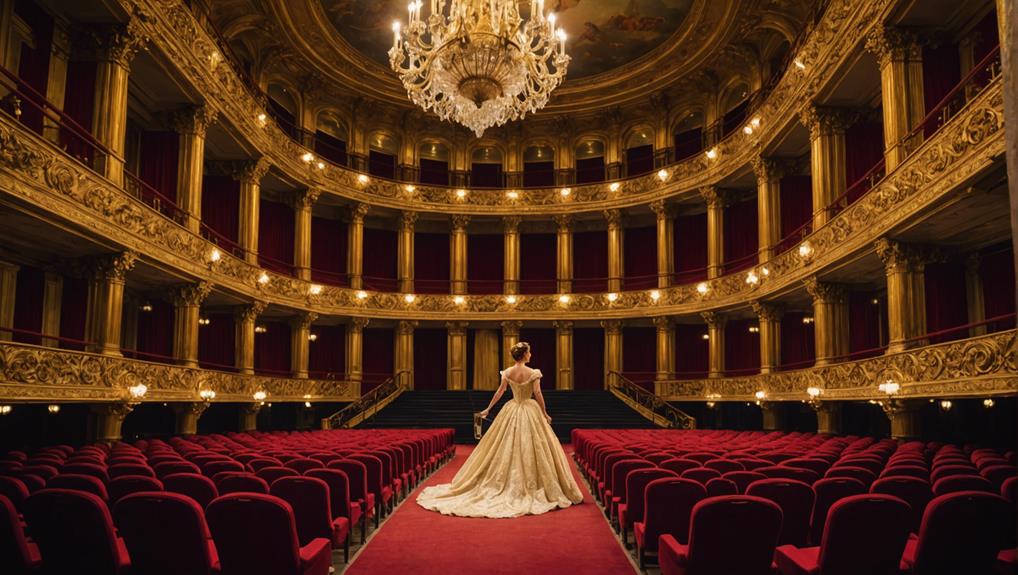
We were thrilled to experience the Met's traditional Tosca, a classic tale of love and deceit that still captivates audiences today. Soprano Elena Stikhina shone as Tosca, alongside tenor Brian Jagde's powerful vocals as Cavaradossi and baritone Željko Lučić's menacing Scarpia. Maestro Carlo Rizzi led the orchestra masterfully, bringing Puccini's iconic score to life. The result was a dramatic intensity that left us on the edge of our seats. If you want to know more about what made this production a triumph, we'll let the curtain rise on the details.
A Timeless Tale of Love and Deceit
As we explore the world of Puccini's Tosca, we find ourselves entangled in a timeless tale of love and deceit, where the fiery passion of its protagonists sets the stage ablaze. We're immersed in a world of operatic passion, where the characters' intense emotions drive the plot forward. At the heart of this tale is the doomed love story of Tosca and Cavaradossi, whose love is tested by the treacherous Scarpia's deceptive motives.
Scarpia, the ruthless and cunning chief of police, will stop at nothing to get what he wants, using deceit and manipulation to achieve his goals. His operatic passion is fueled by his desire for power and control, making him a formidable foe. Meanwhile, Tosca's passion is fueled by her love for Cavaradossi and her determination to protect him from Scarpia's clutches.
As we further explore the story, we're struck by the complexity of the characters' motivations. We see how their passions and desires drive them to make choices that have devastating consequences. We're reminded that love and deceit can be a deadly combination, leading to a tragic downfall.
Through Puccini's masterful score, we're transported to a world of drama and intrigue, where operatic passion and deceptive motives collide. We're left on the edge of our seats, wondering what will happen next in this timeless tale of love and deceit.
Soprano Elena Stikhina Shines Bright
We're immediately captivated by soprano Elena Stikhina's radiant presence as she brings Tosca to life with a voice that's both powerful and precise. Her vocal mastery is on full display as she navigates the complexities of Puccini's score with ease. Stikhina's Tosca is a masterclass in emotional depth, conveying the character's fiery passion and vulnerability with remarkable nuance.
Here are just a few highlights of Stikhina's impressive performance:
- Her voice soars in the iconic "Vissi d'arte," filling the opera house with a sense of longing and desperation.
- Stikhina's chemistry with her co-stars is undeniable, particularly in the tense confrontation with Scarpia.
- Her Tosca is a true diva, commanding the stage with confidence and authority.
- Stikhina's vocal control is stunning, effortlessly moving from tender moments to dramatic outbursts.
Throughout the performance, Stikhina's commitment to the role is palpable, and her emotional depth brings a level of authenticity to the character. We're thoroughly enthralled by her portrayal, and it's clear that Stikhina is a soprano to watch. Her vocal mastery and emotional depth make her Tosca a truly unforgettable experience.
Tenor Brian Jagde's Powerful Vocals
How does tenor Brian Jagde's powerful voice electrify the opera house with his portrayal of Cavaradossi, bringing a sense of urgency to the story? We are thrilled to report that Jagde's vocal prowess is a highlight of this traditional Tosca production. His voice soars with ease, maneuvering the complexities of Puccini's score with confidence and precision.
| Vocal Aspect | Jagde's Strength | Impact on Performance |
|---|---|---|
| Vocal Coaching | Expert guidance | Enhanced vocal control |
| Opera Training | Rigorous practice | Mastery of Cavaradossi's nuances |
| Musical Theater | Versatility in expression | Emotional depth in acting |
| Sound Engineering | Balance of vocal levels | Crisp, clear sound |
Jagde's sound engineering skills are evident in his ability to balance his vocal levels, ensuring that every note rings out clearly. This is particularly impressive in the opera's dramatic moments, where his voice cuts through the orchestra with ease. We attribute this success to his dedication to vocal coaching and opera training, which have honed his skills in managing the demands of Puccini's score. Additionally, his experience in musical theater has allowed him to bring an added layer of emotional depth to his acting, making his Cavaradossi a truly compelling character. With his powerful vocals, Jagde brings a sense of urgency to the story, drawing us in and refusing to let go.
Baritone Željko Lučić's Menacing Scarpia
As we turn our attention to Baritone Željko Lučić's portrayal of Scarpia, we're struck by the menacing aura he brings to the role. His vocal range is perfectly suited to convey the character's sinister charisma, and his dramatic intensity is palpable in every note. We can't help but feel a sense of unease as Lučić's Scarpia takes the stage, his presence commanding our attention.
Vocal Range of Menace
With his rich, velvety tone, Baritone Željko Lučić masterfully navigates the complex vocal range of Scarpia, imbuing the character with a sense of menacing authority. We are drawn into the darkness of Scarpia's world as Lučić's voice conjures up villainous tones that send shivers down our spines. His dark resonance adds depth to the character, making him a formidable foe.
Here are some key aspects of Lučić's vocal range that bring Scarpia to life:
- Low notes of menace: Lučić's ability to hit low notes with ease adds to Scarpia's menacing aura, making him a force to be reckoned with.
- Smooth progressions: Lučić's vocal agility allows him to progress seamlessly between notes, creating a sense of fluidity that complements Scarpia's cunning nature.
- Powerful climaxes: Lučić's powerful vocals during climactic scenes emphasize Scarpia's intensity and authority, making his character all the more believable.
- Subtle nuances: Lučić's subtle vocal nuances add layers to Scarpia's character, revealing a complexity that makes him all the more fascinating.
Scarpia's Sinister Charisma
We're captivated by Lučić's Scarpia, whose sinister charisma permeates every scene, making his character's menacing presence felt throughout the opera. His villainous charm is undeniable, drawing us in with an unsettling allure that's impossible to ignore. As the operatic nemesis, Scarpia's presence is a demonstration of the power of tension and manipulation.
| Characteristics | Scarpia's Traits | Impact on Opera |
|---|---|---|
| Charisma | Sinister, menacing | Pervasive sense of unease |
| Vocal Style | Low, ominous tone | Adds to the sense of foreboding |
| Physicality | Imposing, dominant | Intimidates other characters |
| Intelligence | Cunning, calculating | Outmaneuvers others with ease |
| Presence | Commanding, unsettling | Dominates every scene |
Lučić's Scarpia is a masterful creation, weaving a complex web of menace and intrigue that draws us in, even as we're repelled by his actions. His performance is a demonstration of the power of opera to evoke strong emotions and create a lasting impact.
Dramatic Vocal Intensity
Lučić's commanding Scarpia releases intense vocal drama, his baritone voice oozing with malice as he navigates Tosca's treacherous landscape with calculated precision. We're on the edge of our seats as he skillfully conveys the complexity of his character through vocal nuance and emotional depth. His voice is a sonic boom that reverberates throughout the opera house, sending shivers down our spines.
Here are a few highlights of his performance:
- Pitch-perfect phrasing that sends shivers down our spines
- Harmony clash between his velvety, resonant tone and the dark, foreboding music that underscores his scenes
- A melodic ascent in his voice that portrays Scarpia's scheming nature
- Emotional depth that makes us detest Scarpia, yet can't help but be drawn to his charismatic presence
Through his intense vocal drama, Lučić brings Scarpia to life in a way that's both gripping and unnerving. We can't look away, even as we're repulsed by his character's depravity. It's a true display of Lučić's skill as a performer that he can evoke such a strong reaction from the audience.
Maestro Carlo Rizzi Leads the Orchestra
How did Maestro Carlo Rizzi's masterful baton work its magic on the orchestra, elevating the performance to new heights? As we watched, it was clear that Rizzi's Conductor's Vision was the driving force behind the orchestra's exceptional performance. He coaxed out the Musical Nuances of Puccini's score, balancing the dramatic intensity of the vocals with the lush instrumentation.
| Aspect | Maestro Rizzi's Approach |
|---|---|
| Tempo | Rizzi's deliberate pacing allowed the drama to unfold naturally |
| Dynamics | Subtle contrasts in volume added depth to the performance |
| Articulation | Crisp, precise playing brought clarity to the complex score |
| Balance | The orchestra's sound was expertly balanced, with no section overpowering the others |
| Phrasing | Rizzi's phrasing emphasized the emotional arc of the opera |
With Rizzi at the helm, the orchestra navigated the twists and turns of the score with ease, creating a rich tapestry of sound that perfectly complemented the vocal performances. His interpretation of the score was both nuanced and bold, drawing out the emotional intensity of the opera. We were struck by the orchestra's responsiveness to Rizzi's direction, as if he was conducting an extension of himself. The result was a truly unforgettable performance that left us breathless.
Puccini's Iconic Score Comes Alive
As Maestro Rizzi's masterful baton guided the orchestra through the twists and turns of the score, Puccini's iconic music came alive, swirling around us with a visceral intensity that was truly mesmerizing. The orchestra's response to his leadership was nothing short of phenomenal, as every note, every phrase, and every musical gesture seemed to embody the essence of Puccini's masterpiece.
- The strings sang with a warm, rich tone, evoking the drama and passion of the opera's narrative.
- The woodwinds added a touch of elegance, their phrases dancing across the musical landscape with effortless grace.
- The brass section, meanwhile, brought a sense of urgency and tension, their bold statements punctuating the score with dramatic flair.
- And the percussion, oh the percussion, provided the rhythmic backbone that propelled the music forward, driving the drama to its thrilling conclusion.
Throughout the performance, we were struck by the musical mastery on display. Every section of the orchestra worked in perfect harmony, weaving a rich tapestry of sound that was both beautiful and haunting. And at the heart of it all were the vocal nuances, as the singers brought their characters to life with subtlety and nuance. It was a truly unforgettable experience, one that left us breathless and keen for more.
A Traditional Take on a Classic
We settled into our seats, excited to experience a traditional take on Puccini's beloved opera, one that would stay true to the original's spirit while still feeling fresh and exciting. This classic revival of Tosca promised to transport us to a bygone era, and we couldn't wait to be immersed in the timeless opera's grandeur. As the curtain rose, it was clear that the artistic vision behind this production was one of reverence and respect for the original material. The sets, costumes, and direction all worked in harmony to evoke the historical context in which the story takes place.
What struck us most, however, was the way this traditional take managed to balance historical accuracy with creative freedom. The result was a performance that felt both nostalgic and innovative, staying true to the spirit of Puccini's masterpiece while still offering something new and exciting. It's a tribute to the cultural significance of Tosca that it can continue to captivate audiences to this day, and this production was a powerful reminder of the opera's enduring appeal. As we watched, we were struck by the sense that we were experiencing something truly special – a classic revival that would be remembered for years to come.
The Met Orchestra's Superb Performance
The Met Orchestra, expertly led by conductor Nicola Luisotti, breathed new life into Puccini's iconic score, their superb performance elevating the entire production to new heights. We were utterly captivated by the orchestra's masterful rendering of Tosca's dramatic and emotional landscape. Throughout the performance, the orchestra demonstrated exceptional musical precision, maneuvering through the complexities of Puccini's score with ease.
Some highlights of their performance included:
- The subtle, mournful tones of the cellos in the opening scenes, which set the tone for the tragedy that unfolds
- The burst of energetic strings that accompanied Tosca's defiant 'Vissi d'arte,' showcasing the orchestra's impressive dynamic range
- The haunting, ethereal quality of the woodwinds in the Act II trio, which added an air of mystery to the scene
- The thunderous, pulsing rhythms that propelled the opera towards its dramatic conclusion, leaving us on the edge of our seats
The orchestra's ability to convey the full range of emotions, from tender intimacy to explosive drama, was a validation of their skill and artistry. Under Luisotti's guidance, they coaxed out the orchestral nuance and subtlety that makes Puccini's score so beloved. As we listened, we felt transported to the world of Tosca, thanks to the Met Orchestra's sublime performance.
A Standing Ovation on Opening Night
How did the audience respond to this magnificent performance? We were blown away by the thunderous applause that erupted as the curtain fell on opening night. The excitement was palpable, and we couldn't help but join in, rising to our feet to give the performers a well-deserved standing ovation. It was clear that the cast and crew had left everything on the stage, and we were thrilled to be a part of this special night.
As the performers took their final bows, we couldn't help but feel a sense of pride and gratitude towards the entire team. The Opening Night Jitters were clearly a distant memory, replaced by an infectious energy that spread throughout the auditorium. We cheered and whistled, acknowledging the hard work and dedication that had gone into bringing this production to life.
As the curtain call traditions dictated, the principal singers took their final bows, beaming with pride and gratitude. We applauded until our hands were sore, but we just couldn't get enough of this incredible performance. It was clear that this traditional Tosca had won over the hearts of everyone in attendance, and we felt honored to have been a part of it. As we filed out of the opera house, we couldn't stop talking about the magic we had just witnessed. It was a night to remember, and we couldn't wait to see what the rest of the run had in store.
A Stellar Cast Brings Tosca to Life
As we explore the stellar cast that brings Tosca to life, we're struck by the sheer vocal power on display. We're treated to performances that balance technical prowess with dramatic intensity, drawing us into the opera's dark and twisted world. With these talented artists at the helm, the magic of opera is truly revived.
Vocal Powerhouses Shine
Soprano Anna Netrebko, tenor Yusif Eyvazov, and baritone Michael Volle bring Tosca to life with their powerhouse vocals, each one a master of their craft. We're witnessing opera legends in the making, and it's a thrill to behold. Their vocal technique is impeccable, with each note delivered with precision and power.
- The trio's stage presence is electrifying, drawing us in with their convincing portrayals of Tosca, Cavaradossi, and Scarpia.
- Their classical roots are evident in their musical mastery, as they navigate the complexities of Puccini's score with ease.
- The sonic boom of their voices is awe-inspiring, filling the opera house with rich, resonant sound.
- As we listen, we're transported to a world of drama and passion, where the music is the true star of the show.
With these vocal powerhouses leading the way, we're treated to an unforgettable performance that will leave us cheering for more. The Met has truly outdone itself with this production, and we're honored to be a part of it.
Dramatic Intensity Unleashed
We're completely absorbed in the dramatic intensity of Tosca, thanks to a stellar cast that brings this timeless tale to life with unrelenting passion and conviction. The emotional turbulence that defines this opera is palpable, as the cast masterfully navigates the complex web of relationships and motivations. The tension is tangible, and we feel ourselves drawn into the world of Tosca, Cavaradossi, and Scarpia.
The vocal ferocity of the cast is awe-inspiring, as they tackle the demanding score with ease and precision. The dramatic intensity is released in every aria, every duet, and every chorus. We're on the edge of our seats as Tosca's desperation grows, and Cavaradossi's defiance is met with Scarpia's ruthless determination. The cast's commitment to their characters is total, and we're swept up in the emotional turmoil that drives the story forward. It's a truly immersive experience, and we're grateful to be along for the ride. With a cast this talented, it's no wonder that Tosca remains an opera classic.
Opera Magic Revived
How does a single production manage to revive the magic of opera, transporting audiences to a world of drama and passion? We've witnessed it firsthand with this traditional Tosca, which has brought a Cultural Revival to the Met. The secret lies in the perfect blend of talent, direction, and production values.
Here's what makes this production truly unforgettable:
- A stellar cast that brings depth and nuance to their characters, making the drama feel intensely personal.
- Lavish sets and costumes that transport us to Rome during World War I, immersing us in the world of the opera.
- A conductor who coaxes the orchestra to produce a rich, sweeping sound, elevating the drama to new heights.
- A director who trusts the material, allowing the opera's inherent drama to shine through, unencumbered by unnecessary gimmicks.
This production marks an Artistic Renaissance, reminding us why Tosca remains a beloved classic. As we leave the opera house, we can't help but feel grateful for the experience, and keen to return to the world of opera once again.
The Triumph of Luc Bondy's Production
Luc Bondy's production of Tosca, which debuted in 2009, has been a game-changer for the Met, boasting a modernist twist that has reinvigorated the classic opera. We were thrilled to revisit this iconic production, and it's clear why it's remained a fan favorite. The director's vision is evident in every aspect of the production, from the stage design to the performances.
One of the standout aspects of Bondy's production is its ability to balance traditional elements with modern flair. This blend of old and new is perfectly captured in the stage design, which features a striking combination of grand, ornate sets and sleek, modern touches.
| Element | Description |
|---|---|
| Stage Design | Grand, ornate sets with modern touches |
| Director's Vision | Modernist twist on a classic opera |
| Performances | Powerful, emotionally charged performances |
The result is a production that feels both timeless and timely, with a unique energy that draws the audience in. We were on the edge of our seats as Tosca navigated the treacherous world of 19th-century Rome, and the production’s clever use of lighting and staging only added to the tension. Overall, Luc Bondy’s production of Tosca is a triumph, and we’re so glad it’s back at the Met. The powerful performances and evocative orchestration further enhance the emotional depth of the opera, making each moment resonate with the audience. The intensity of the production is reminiscent of the gripping improvisations one might experience at a Bad Plus at Village Vanguard performance—unpredictable, electrifying, and profoundly moving. As the final notes echoed through the theater, it was clear that this revival remains a must-see for opera lovers everywhere.
A Night to Remember at the Met
As we settled into our seats at the Metropolitan Opera House, the excitement was tangible, and we knew we were in for a night to remember. The anticipation was electric, and the Met expectations were high. The opera atmosphere was palpable, with the ornate chandeliers, gilded balconies, and plush red seats setting the tone for a magical evening.
- The grandeur of the opera house enveloped us, making us feel like royalty for the night.
- The soft glow of the stage lights illuminated the expectant faces of the audience, all eager to be transported to a world of drama and music.
- The rustle of programs, the whispers of excitement, and the occasional cough were the only sounds breaking the silence, as the crowd held its collective breath in anticipation.
- The air was alive with the promise of a spectacular performance, and we couldn't wait to be swept away by the music, drama, and passion of Tosca.
As the lights dimmed, and the orchestra began to play, we knew that this was going to be a night to remember. The music swelled, the curtain rose, and we were transported to the world of Puccini's Tosca. The Met expectations were not only met but exceeded, as the opera atmosphere was electric, and the performances were nothing short of breathtaking. It was indeed a night to remember at the Met.
Frequently Asked Questions
What Time Does the Opera Performance Typically Start at the Met?
When we head to the Met, we're always curious about the evening schedule. We want to know what time the opera performance typically starts. Luckily, the Met's curtain time is usually around 7:30 pm for evening performances. We make sure to arrive a bit earlier to soak in the pre-show atmosphere. With our tickets in hand, we're ready for an unforgettable night of music and drama!
Is Tosca Suitable for Young Children to Attend?
We're often asked if Tosca is suitable for young children to attend. Honestly, we think it's not recommended for kids under 12. The opera deals with mature themes, including violence, torture, and betrayal, which may be disturbing for younger kids. Age guidance aside, it really depends on a child's emotional maturity. If your kid can handle intense scenes and complex emotions, then maybe. But generally, we think it's better suited for teenagers and above.
Can I Take Photos During the Performance?
We're excited to attend the performance, but we're unsure about taking photos during the show. Generally, it's best to check with the venue or production team beforehand. Flash photography is usually a no-go, as it can distract the performers and audience. We should practice good camera etiquette and avoid taking photos during the performance. If we must capture memories, we can try taking photos during intermission or before the show starts.
Are Refreshments Available for Purchase at the Met?
'We're excited to grab a snack or drink during the performance! Yes, refreshments are available for purchase at the Met. We're looking forward to exploring the concession options, which offer a range of food and beverages. From what we've heard, the food quality is exceptional, so we can't wait to indulge and enhance our overall experience.'
Is There a Dress Code for Attending the Opera at the Met?
We're wondering about the dress code for attending the opera at the Met. While there isn't a strict rule, we like to follow traditional formal etiquette. For evening performances, we opt for evening attire, which means men wear suits and ties, and women dress up in cocktail dresses or elegant gowns. It's a special night out, and we want to show respect for the art form and the venue.
About the Author


